

Artificial intelligence has moved from an experimental buzzword to a working part of how property is bought, sold, financed, and managed. From automated valuation models that reprice listings overnight to AI agents that qualify leads at 3 a.m., the real estate industry is undergoing what McKinsey & Company calls a shift “beyond isolated tools toward full workflow transformation.” Dubai and the wider UAE are positioning themselves at the center of this shift, pairing government-led AI adoption with one of the world’s most active property markets. This guide breaks down exactly how AI is changing real estate investing today, what it means for investors, homebuyers, brokers and developers, and where the real opportunities sit in Dubai’s market specifically.
Executive Summary
AI is now embedded across nearly every stage of the property lifecycle: search and matching, automated valuation, predictive market forecasting, lead generation, day-to-day property management, mortgage underwriting, and fraud detection. McKinsey Global Institute estimates AI could unlock 430 billion to 550 billion US dollars in value across the global real estate value chain, while the World Economic Forum reports that 90% of real estate companies are now testing AI solutions, up from just 5% three years ago. In Dubai, the Dubai Land Department has already deployed an AI-powered Real Estate Advertising Governance Platform that has reviewed over 279,000 property advertisements, automatically correcting 29% of them, showing that AI adoption in the region is not theoretical but operational today.
Key Takeaways
- AI is reshaping property search, valuation, forecasting, lead generation, management, financing, and fraud detection simultaneously, not in isolation.
- McKinsey estimates AI could create up to $550 billion in value across the real estate value chain globally.
- Dubai’s government has already deployed AI in real estate oversight through the DLD’s Advertising Governance Platform and continues to expand AI-driven digital services.
- AI adoption is accelerating faster than organizational readiness: WEF-cited research shows only 5% of real estate firms report achieving their AI goals despite 90% now experimenting with it.
- Investors, brokers, developers, and homebuyers each benefit differently from AI, and understanding these differences helps in choosing the right tools.
- AI complements rather than replaces real estate professionals; the highest-performing firms combine AI speed with human judgment.
Table of Contents
- Executive Summary
- AI in Property Search
- AI-Powered Property Valuation
- Predictive Analytics in Real Estate
- AI in Market Forecasting
- AI for Lead Generation
- AI in Property Management
- AI in Mortgage and Financing
- AI in Fraud Detection
- AI and Smart Cities
- AI Opportunities in Dubai Real Estate
- Real-World AI Examples
- Future Trends
- Pros and Cons of AI in Real Estate
- Frequently Asked Questions
- Sources and References

AI in Property Search
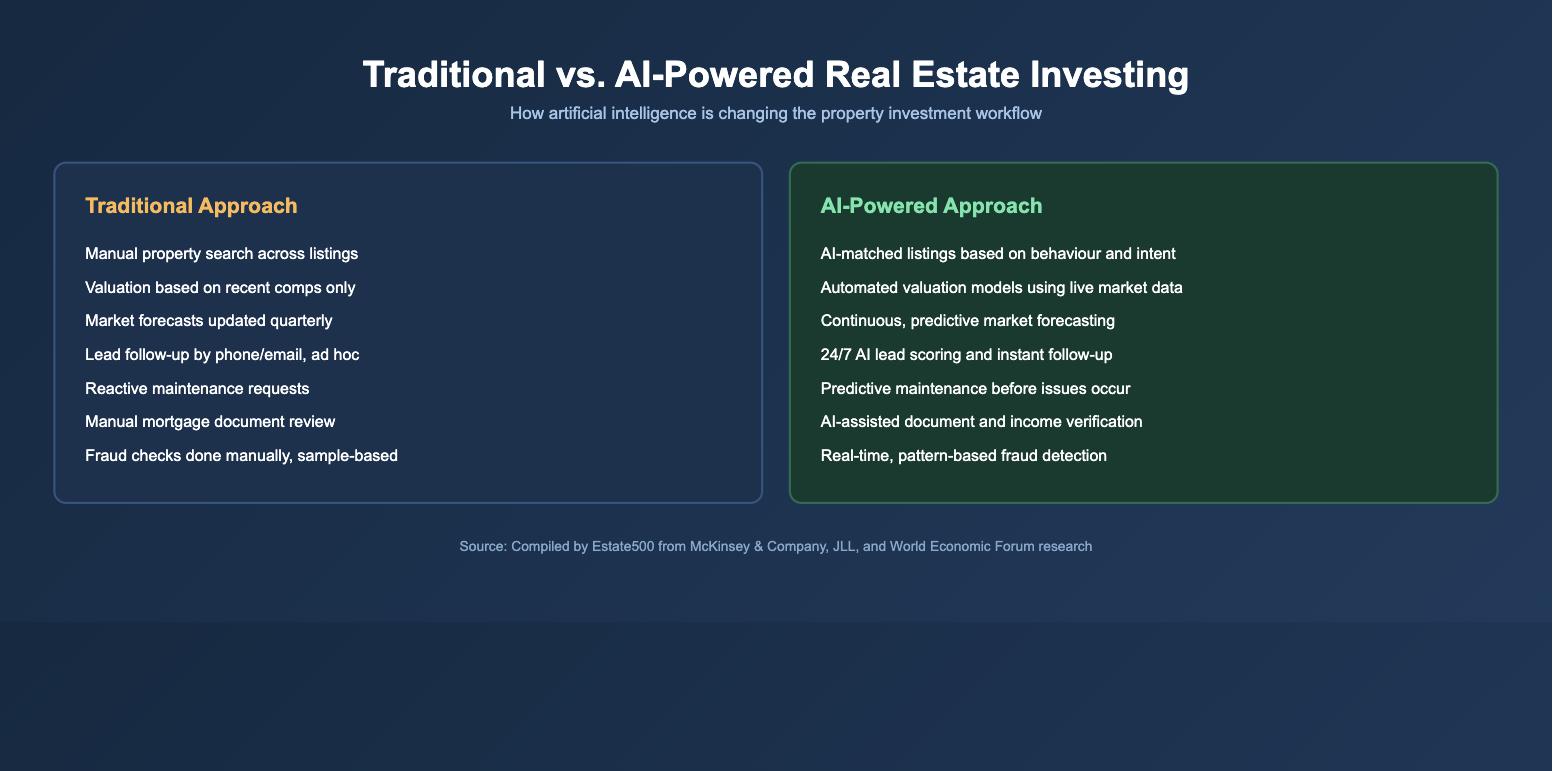
Finding the right property used to mean scrolling through hundreds of listings and filtering by price, location, and bedroom count. AI-powered search platforms now learn from a buyer’s browsing behaviour, saved searches, and even the amount of time spent looking at specific photos to surface listings that match unstated preferences, not just stated filters. Platforms like HayyAI in the UAE market are built specifically around this model, using AI to help users find, compare, and shortlist Dubai properties faster than manual browsing allows.
How AI Matching Works
Modern property search tools use natural language processing to let buyers describe what they want in plain language, then rank inventory using a mix of collaborative filtering (what similar buyers liked) and content-based filtering (matching the property’s own attributes). The result is a shortlist that improves the more a buyer interacts with the platform.

AI-Powered Property Valuation
Automated Valuation Models (AVMs) use machine learning to estimate a property’s market value by analyzing recent comparable sales, location data, property condition indicators, and macroeconomic signals simultaneously. Unlike a traditional appraisal that might rely on three to five recent comps, an AVM can weigh thousands of data points and update its estimate as new transactions are recorded. CBRE Investment Management notes that AI is “driving deeper understanding and greater efficiency” in real estate investment, from personalized investor insights to faster market research.
Why Valuation Speed Matters for Investors
In fast-moving markets like Dubai, where transaction volumes and prices can shift within a single quarter, faster and more frequently updated valuations help investors avoid overpaying and identify undervalued opportunities before they become widely known.
Predictive Analytics in Real Estate
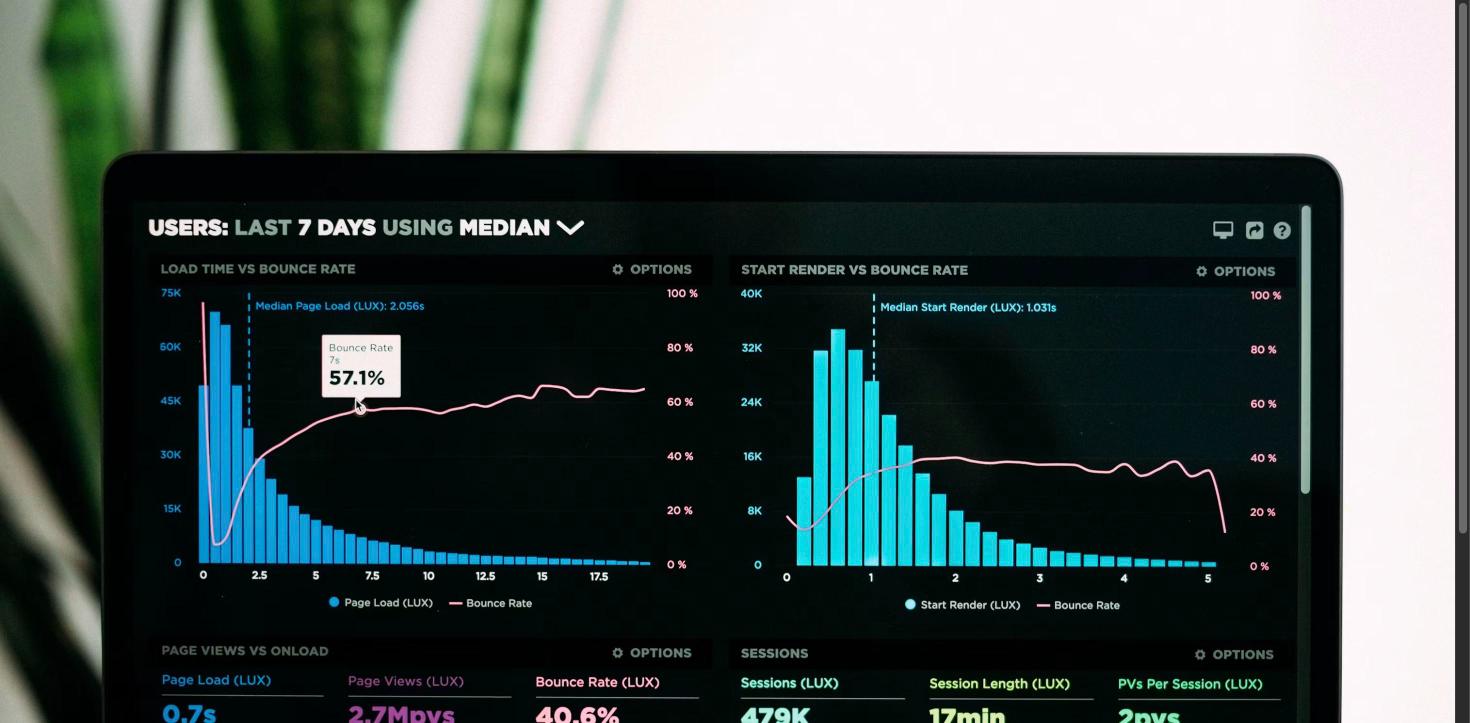
Predictive analytics goes a step beyond valuation by forecasting how prices, rental yields, and occupancy rates are likely to move over time. These models ingest historical pricing, population growth, infrastructure project timelines, interest rate trends, and even search-engine demand signals to project future performance for specific neighbourhoods or asset classes. For investors, this shifts decision-making from reactive (“what happened last quarter”) to proactive (“what is likely to happen next”).
Data Sources Behind the Models
Quality predictive models depend on clean, governed data. As McKinsey partner Ankit Kapoor put it, “If you build an AI agent on top of erroneous or dirty data, it is going to take an action based on that data, and you are going to have an erroneous outcome.” This is why the most reliable AI forecasting tools are built on official transaction registries, such as government land department data, rather than scraped or unverified listings.
AI in Market Forecasting
Beyond individual property predictions, AI is now used to forecast entire market cycles. JLL’s research hub on artificial intelligence highlights how AI combined with human valuation expertise creates more reliable forecasts than either approach alone, describing it as “a powerful team of real data and insights.” Gartner’s Top Strategic Technology Trends for 2026 similarly points to multiagent AI systems as a growing force in how organizations, including real estate firms, process and act on complex forecasting data.
Segment-Level Forecasting
JLL’s broader labor-market research also shows that AI’s effects are uneven across the industry, describing the trend as AI “segmenting markets, not moving them uniformly.” This means some property types and locations will see AI-driven efficiency gains much faster than others, making sector-specific forecasting more valuable than broad, market-wide predictions.
AI for Lead Generation
Brokerages are increasingly using AI to qualify and prioritize leads automatically. Rather than a human agent manually following up with every inquiry, AI systems can score leads based on browsing behaviour, response speed, and stated budget, then trigger instant personalized follow-up messages any time of day. McKinsey’s research on real estate workflows found that moving leasing from a 9-to-5 model to a 24/7 AI-enabled engagement model helps firms “capture more leads and prevent leakage” that would otherwise be lost to slower response times.
From Cold Leads to Qualified Buyers
AI lead-scoring tools typically rank prospects using dozens of behavioural signals, allowing agents to spend their limited time on the leads most likely to convert, rather than treating every inquiry equally.
AI in Property Management
Property management has become one of the clearest early-value areas for AI. Predictive maintenance systems flag equipment issues before they cause costly failures, AI chatbots handle routine tenant questions instantly, and smart building sensors automatically adjust energy usage. A recent Khaleej Times report on the UAE’s Agentic AI push highlighted how companies like Facilio are “embedding AI into real estate operations platforms, allowing facilities teams to use voice commands” to manage buildings more efficiently, a shift industry watchers describe as a move from dashboards that show information to systems that take action.
Smart Access and Predictive Maintenance
AI-connected smart locks, sensors, and building management systems allow property managers to automate access control, detect anomalies, and schedule maintenance proactively, rather than waiting for tenants to report a problem.

AI in Mortgage and Financing
Mortgage underwriting has traditionally been slow, paperwork-heavy, and dependent on manual income verification. AI is compressing this timeline significantly. EY’s research on generative AI in commercial real estate points to AI’s growing role in automating financial analysis and risk assessment, while broader industry data shows AI-assisted document processing can cut reporting and reconciliation time by 60% to 80% for some workflows, according to McKinsey’s real estate practice.
Automated Income and Risk Verification
AI models can cross-reference bank statements, employment data, and credit history far faster than manual review, flagging inconsistencies for human underwriters to examine rather than requiring a full manual check on every application. This does not remove the underwriter, but it changes their role toward reviewing exceptions rather than processing every file from scratch.

AI in Fraud Detection
Real estate transactions involve large sums of money moving between multiple parties, making the sector a persistent target for fraud, from fake listings to title fraud and wire-transfer scams. AI-based fraud detection systems monitor transaction patterns in real time, comparing new activity against historical norms to flag anomalies that would be difficult for a human reviewer to catch manually. Dubai’s own regulatory approach illustrates this directly: the Dubai Land Department’s AI-powered Real Estate Advertising Governance Platform has monitored more than 279,000 property advertisements across major marketing platforms, automatically correcting 29% of them to ensure listings meet regulatory standards.
Why This Matters for Investors
For investors, AI-driven oversight of listings and transactions reduces the risk of engaging with fraudulent or misrepresented properties, adding a layer of market-wide protection that did not exist when monitoring relied purely on manual audits.

AI and Smart Cities
Real estate does not exist in isolation from the cities around it, and AI is increasingly used to plan and operate entire urban environments. NVIDIA’s smart-city platform, built on tools like Omniverse, enables what the company describes as “physically accurate digital twins and city-scale simulations to help cities design infrastructure, anticipate challenges, and optimize” operations. These digital twins let planners simulate traffic flow, energy demand, and building performance before construction even begins, directly affecting which areas become the next high-growth real estate corridors.
Why Smart Cities Matter for Property Value
Areas that adopt smart infrastructure, from AI-optimized traffic systems to predictive utility management, tend to attract long-term investment because they reduce operating costs and improve quality of life, both of which support property values over time.
AI Opportunities in Dubai Real Estate
Dubai has taken a notably proactive, government-led approach to AI in real estate, rather than leaving adoption purely to private platforms. The Dubai Land Department’s AI-powered Real Estate Advertising Governance Platform, launched during GITEX 2024, actively monitors advertisements across major portals including Property Finder, Dubizzle, and Bayut. Ali Abdullah Al Ali, Director of the Real Estate Control Department at DLD’s Real Estate Regulatory Agency, said the platform “enables us to monitor advertisements more accurately and efficiently, enhancing investor and consumer confidence and reinforcing Dubai’s position as a global hub for real estate innovation.”
A Coordinated Regulatory Approach
Dubai’s approach spans multiple authorities: the Dubai Land Department oversees property registration and market integrity, while broader digital and virtual asset activity intersects with agencies such as the Virtual Assets Regulatory Authority (VARA) for technology-driven financial products. This layered structure gives investors a clearer regulatory picture than markets where AI adoption in real estate remains largely unregulated.
What This Means for Investors and Developers
For investors, Dubai’s AI-driven oversight reduces exposure to fraudulent listings and improves transaction transparency. For developers and brokers, it raises the bar on marketing compliance, since AI systems can automatically detect and correct non-compliant advertisements at scale. For homebuyers, it means more standardized, verifiable information when comparing properties across platforms.
Real-World AI Examples
Beyond Dubai’s regulatory platform, several real-world applications illustrate how AI is already operating inside real estate businesses. Facilio, a proptech operations platform active in the UAE, uses AI agents to let facilities teams manage buildings through voice commands rather than manually navigating dashboards, according to Khaleej Times reporting. On the investment side, McKinsey’s interviews with real estate executives describe organizations cutting financial reporting time by 60% to 80% by having AI aggregate, compile, and generate bespoke reports automatically, compared with fully manual processes. On the valuation side, CBRE Investment Management highlights AI’s growing role in “creating personalized experiences for investors” and “speeding up market research” across investment decision-making.
Future Trends
Looking ahead, several trends are likely to define the next phase of AI in real estate. Gartner’s Top Strategic Technology Trends for 2026 highlights multiagent systems, described as dividing work among task-specialized AI agents to boost efficiency, a model likely to expand from back-office real estate operations into more customer-facing roles. McKinsey’s research points toward “agentic AI” moving the industry beyond isolated tools toward full workflow transformation, where coordinated AI agents manage entire processes such as leasing or maintenance from start to finish rather than automating single steps. In Dubai specifically, continued government investment in AI-driven regulatory platforms suggests the market will keep expanding oversight and transparency tools, potentially becoming a global reference model for AI-regulated real estate markets. Meanwhile, broader shifts toward generative AI, following the rapid rise of tools popularized by OpenAI, are already being adopted for listing descriptions, contract summarization, and customer communications across the industry.
Pros and Cons of AI in Real Estate
Pros
- Faster, more data-driven property valuations and market forecasts.
- Round-the-clock lead engagement that reduces missed opportunities.
- Predictive maintenance that lowers long-term property management costs.
- Faster mortgage processing through automated document and income verification.
- Improved fraud detection and market transparency, as demonstrated by Dubai’s AI-monitored advertising platform.
- Better matching between buyers and properties, reducing wasted search time.
Cons
- AI models are only as reliable as the data they are trained on; poor data leads to poor predictions.
- Many organizations are experimenting with AI without the operational readiness to scale it, per WEF-cited research showing only 5% of firms achieve their stated AI goals.
- Over-reliance on automated valuation models can miss property-specific nuances that a human appraiser would catch.
- Data privacy and cybersecurity risks grow as more personal and financial data flows through AI systems.
- Regulatory frameworks for AI in real estate are still developing in many markets, creating some uncertainty.
Frequently Asked Questions
Will AI replace real estate agents?
Most industry research suggests AI is more likely to change agents’ roles than eliminate them entirely. AI handles repetitive tasks like lead scoring, document review, and initial property matching, while agents focus more on negotiation, relationship-building, and complex decision-making, the “human moments that matter,” as McKinsey’s Alex Wolkomir describes them.
How is AI used in real estate investing specifically?
Investors use AI for automated property valuation, predictive market forecasting, deal screening against historical acquisition criteria, and portfolio-level risk analysis, allowing them to evaluate more opportunities in less time than manual analysis would allow.
Is AI accurate for property valuation?
AI-based automated valuation models can be highly accurate for standard residential properties in data-rich markets, but accuracy drops for unique or luxury properties with fewer comparable sales. Most professionals treat AI valuations as a strong starting point that should be reviewed alongside human expertise for higher-value or unusual assets.
How is Dubai using AI in real estate?
The Dubai Land Department operates an AI-powered Real Estate Advertising Governance Platform that has monitored over 279,000 property listings and automatically corrected 29% of them for compliance, alongside a broader push toward Agentic AI adoption across the UAE’s private sector, including property management platforms like Facilio.
What skills should real estate professionals develop for an AI-driven market?
Skills in data interpretation, AI-tool literacy, and client relationship management are becoming more valuable, since McKinsey’s research suggests future real estate roles will shift toward judgment-based decision-making and exception handling rather than manual data processing.
Is investing in AI-driven real estate platforms risky?
As with any technology-driven investment approach, risk depends on the platform’s data quality, regulatory oversight, and track record. Platforms operating within clearly regulated markets, such as those overseen by Dubai’s government authorities, generally offer more transparency than unregulated alternatives. This is general information, not financial advice, and investors should conduct independent research or consult a licensed advisor before making investment decisions.
Sources and References
- McKinsey & Company – Where AI Is Creating Real Value in Real Estate
- Dubai Land Department – AI-Enabled Real Estate Advertising Governance
- World Economic Forum – Real Estate’s AI Success Depends on People, Not Technology
- JLL – Artificial Intelligence Insights (UAE)
- Gartner – Top Strategic Technology Trends for 2026
- NVIDIA – Build Smart Cities With AI
- Khaleej Times – UAE’s AI Push Puts Real Estate at the Centre of Its Digital Future
- CBRE Investment Management – Unlocking the Potential of AI in Real Estate Investment
- PwC – AI Adoption and Workforce Transformation in Real Estate
- EY – Generative AI Is Transforming Commercial Real Estate
Explore Dubai Property Investment Opportunities with Estate500
AI is making real estate research faster and more data-driven, but choosing the right property still benefits from local expertise. Browse our current apartments for sale in Dubai or explore the full range of Dubai property listings curated with market insight behind every recommendation. Curious how emerging investment models compare? Read our guide to tokenized real estate vs. REITs, or check our Dubai real estate market overview. If you are relocating or investing as an overseas buyer, see how property ownership connects to the UAE Golden Visa. Ready to put data-driven insight to work for your next investment? Contact the Estate500 team today.
Disclaimer: This article is provided for general educational and informational purposes only and does not constitute financial or investment advice. Real estate values and AI-generated forecasts can vary and are not guarantees of future performance. Always conduct independent research and consult a licensed professional before making investment decisions.